

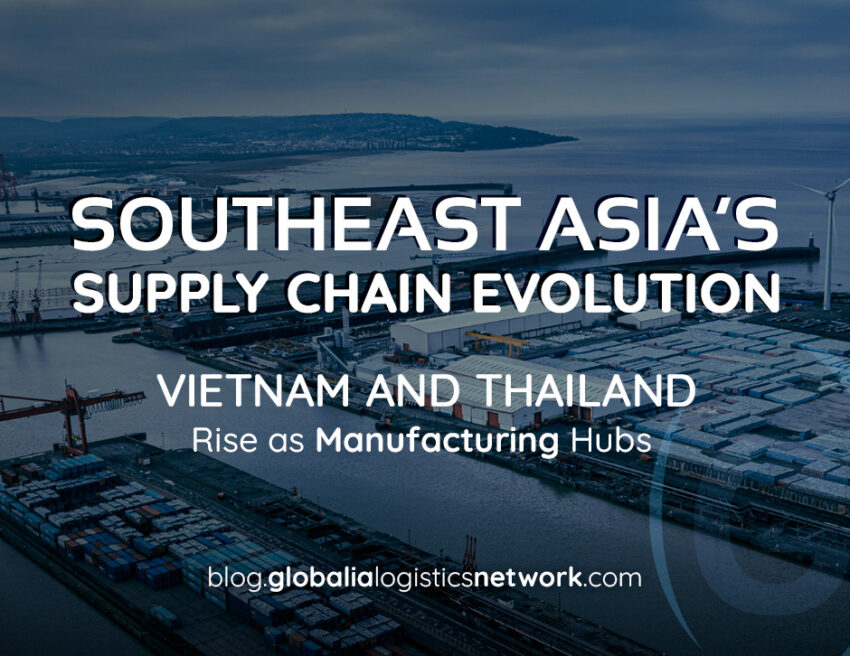
Over the past decade, the South East Asia supply chain has transformed from a peripheral player into one of the most dynamic engines of global trade. While China continues to dominate manufacturing, countries like Vietnam and Thailand are rapidly emerging as the next big manufacturing powerhouses. The shift is about resilience, diversification, and strategic opportunity.
Let’s take a look at how these two nations are reshaping the ASEAN supply chain and what it means for global logistics, investment, and the future of manufacturing in Southeast Asia.
The Push Behind the Shift: Beyond China’s Borders
The story begins with the China Plus One strategy, a term now familiar across boardrooms and factory floors. As trade tensions, rising labor costs, and pandemic disruptions challenged China’s manufacturing dominance, companies began seeking alternative production bases. This gave birth to the supply chain shift from China to Southeast Asia, with Vietnam and Thailand leading the way. Both nations offer strategic geography, competitive labor costs, improved infrastructure, and trade agreements that open doors to global markets. What this really means is that multinationals are diversifying rather than abandoning China. This diversification ensures that production doesn’t stop if one node in the global supply chain faces disruption.
Vietnam’s Manufacturing Boom
Vietnam has earned a reputation as a manufacturing hub almost overnight. Global giants like Samsung, Apple, Nike, and Foxconn have established production bases there, drawn by low labor costs and a young, skilled workforce. The country’s proximity to China allows companies to relocate part of their production without losing access to Chinese suppliers. Add to that Vietnam’s participation in free trade agreements like the CPTPP and RCEP, and you get a country deeply integrated into the global value chain.
Infrastructure is catching up fast. Ports like Hai Phong and Cai Mep-Thi Vai have expanded capacity, while road and rail connectivity to industrial zones continue to improve. This infrastructure development in Vietnam and Thailand logistics, combined with government-friendly investment policies, has made Vietnam one of the most attractive destinations for factory relocation in Asia. But there’s more than just low costs. Vietnam is climbing the value chain. Electronics, automotive parts, and renewable energy components are replacing traditional textile exports. It’s a clear signal that Vietnam’s growth is structural.
Thailand’s Manufacturing Powerhouse
While Vietnam grabs headlines for its rapid rise, Thailand has been an established manufacturing player for decades. Known for its robust automotive and electronics industries, the Thailand manufacturing hub is now transitioning into high-tech production and sustainable industries.
The country’s Eastern Economic Corridor (EEC) is a major draw for investors. It’s part of Thailand’s long-term vision to position itself as a regional logistics and innovation hub. New ports, highways, and high-speed rail networks linking Thailand to Laos, Cambodia, and Vietnam are expanding regional connectivity across the ASEAN supply chain. Multinationals looking at comparing Vietnam vs Thailand for manufacturing often find Thailand has an advantage in infrastructure and supply chain maturity, while Vietnam wins on cost and growth potential. In reality, both countries complement each other. Vietnam excels in assembly and light manufacturing, while Thailand leads in engineering and production scale.
The China Plus One Strategy in Action
The China Plus One strategy is a fundamental rebalancing of global manufacturing. Companies aren’t pulling out of China but diversifying their risk by building production capacity in South East Asia supply chain networks. Apple’s suppliers, for example, have expanded production in both Vietnam and Thailand. Similarly, automotive firms are integrating both markets into their regional production strategies. This movement has created a ripple effect across logistics, warehousing, and transport infrastructure. Ports in Vietnam and Thailand are modernizing. Inland container depots, cross-border trucking routes, and digital customs clearance systems are all being upgraded to handle increasing trade volumes.
Comparing Vietnam and Thailand for Manufacturing
When it comes to comparing Vietnam vs Thailand for manufacturing, each has its strengths.
-
Vietnam attracts companies seeking rapid setup, lower operational costs, and strong export links to the U.S. and Europe. Its young workforce and growing industrial zones near Hanoi and Ho Chi Minh City make it ideal for labor-intensive sectors.
-
Thailand, meanwhile, offers stability, advanced logistics, and technical expertise. It’s perfect for high-tech and automotive industries, supported by a well-developed supply chain and superior energy infrastructure.
The choice often depends on a company’s goals. Companies chasing agility and growth pick Vietnam, while those valuing precision and scale tend to choose Thailand.
Investing in ASEAN Supply Chain Networks
For investors and logistics players, investing in ASEAN supply chain networks is becoming a strategic imperative. Southeast Asia now accounts for a growing share of global trade in electronics, consumer goods, and automotive components. Regional integration through agreements like the ASEAN Economic Community (AEC) and RCEP is lowering barriers and harmonizing regulations, allowing goods to move more freely between member states. This interconnectedness strengthens the entire South East Asia supply chain, making it more competitive and resilient. Freight forwarders, warehousing operators, and logistics technology providers are all expanding in this region. The goal is to capture the flow of goods moving between China, Southeast Asia, and global export markets.
How Freight Forwarders Can Thrive with Globalia Logistics Network
Amid this rapid transformation, small and mid-sized logistics companies in Vietnam, Thailand, and the wider ASEAN region have an enormous opportunity to scale up by joining a trusted international network like Globalia Logistics Network. As one of the top-tier freight forwarders’ networks in the world, Globalia connects independent logistics companies with reliable partners across more than 125 countries. By joining, forwarders in these fast-growing markets can gain global exposure, secure new business from verified partners, and strengthen their credibility in international logistics. In a region where cross-border cooperation and trust are key, being part of Globalia can make all the difference, helping local forwarders grow both within the community and beyond.
Not a member yet? Join us today!
Infrastructure Development in Vietnam and Thailand Logistics
A crucial part of this evolution lies in infrastructure. Both countries are investing heavily in ports, airports, and road networks. Vietnam’s Long Thanh International Airport, once completed, will handle 100 million passengers and millions of tonnes of cargo annually. In Thailand, the Laem Chabang Port expansion and new rail corridors linking to the Mekong region will boost logistics capacity and reduce transit times.
For logistics companies, this creates enormous opportunities. Apart from cost-cutting, efficient infrastructure also enhances supply chain reliability, a key factor for global manufacturers choosing where to relocate production.
The Future of Manufacturing in Southeast Asia
The future of manufacturing in Southeast Asia is about technology, sustainability, and regional integration. As Vietnam and Thailand continue to modernize, digital supply chain solutions will become standard. More importantly, environmental standards are tightening. Both governments are encouraging green factories, renewable energy use, and sustainable logistics practices. This aligns with the global push for ESG compliance and makes Southeast Asia even more attractive to Western investors seeking cleaner supply chains.
Why Companies Are Moving to Vietnam and Thailand
So, why are companies moving to Vietnam and Thailand? It’s not just about escaping high costs in China. It’s about future-proofing their operations. These nations offer a rare combination of cost efficiency, skilled labor, favorable policies, and improving infrastructure. They also provide access to a fast-growing consumer base of over 600 million people across ASEAN. The South East Asia supply chain is becoming a central player in global manufacturing strategy.
Final Thoughts
Vietnam and Thailand’s rise as manufacturing hubs is a logistics transformation. The factory relocation in Asia wave is redefining trade flows, shipping routes, and warehouse networks across the region. For freight forwarders, logistics providers, and investors, this is the moment to look closely at Southeast Asia. As these nations strengthen their position within the ASEAN supply chain, they’re building something uniquely their own.