


Kansas City may sit far from the US coast, but its central location makes it one of the most important inland logistics hubs in North America. At the intersection of major highways, rail networks, and intermodal facilities, the city connects manufacturers, distributors, and retailers with markets across the United States, Canada, and Mexico. For companies planning regional distribution or cross-border movements, understanding the role of the Kansas City supply chain can reveal important opportunities for improving freight efficiency and market access.
The city’s logistics importance is closely linked to its geography. Interstate 35 provides a major north-south connection towards Canada and Mexico, while Interstate 70 runs east-west across the United States. Together with other major highways serving the region, these routes make Kansas City a natural meeting point for domestic and international freight.
Why Kansas City Is a Strategic Logistics Hub
Kansas City has developed around transportation for more than a century, with railways playing a particularly important role in its growth. Today, the metropolitan area combines road, rail, air and river infrastructure, allowing businesses to choose between different modes depending on the cargo, destination and delivery requirements. The region is home to several major Class I railroads, including BNSF Railway, Union Pacific, Norfolk Southern and Canadian Pacific Kansas City. This extensive rail presence supports long-distance freight movements and gives businesses alternatives to relying exclusively on trucking.
Intermodal infrastructure is another major advantage. Logistics Park Kansas City in Edgerton, Kansas, provides domestic and international intermodal services and connects rail operations with large-scale distribution facilities. Across the state line, the Kansas City metropolitan area also has intermodal terminals operated by major rail carriers.
This combination is particularly valuable for supply chains that need to balance transportation cost with speed. Rail can handle long-distance movements efficiently, while trucks provide the flexibility required for first- and last-mile delivery.
Kansas City and North American Trade
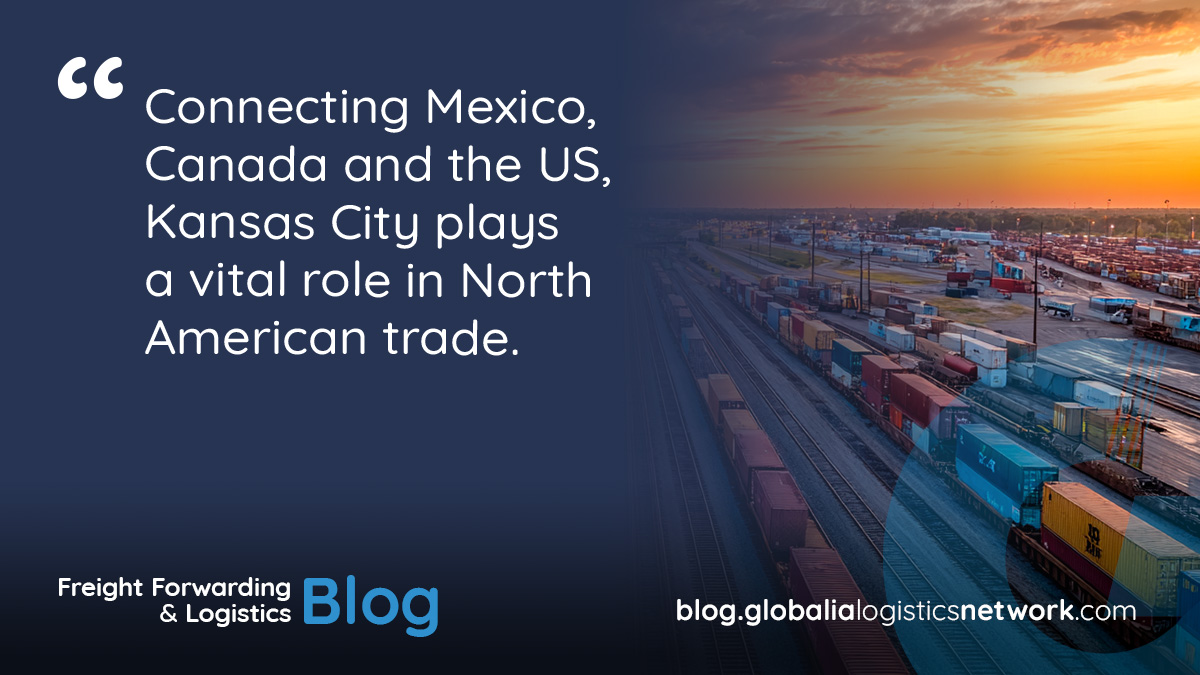
The city’s location becomes even more significant when viewed in the context of North American trade. Kansas City sits along the I-35 corridor, which connects the US with both Canada and Mexico. This makes it strategically positioned for companies moving goods between the three countries. For manufacturers and distributors, the ability to bring products into the region and then distribute them across different US markets can reduce the need for multiple distribution points. Kansas City is within a one-day drive of a large share of the US population, while regional logistics organizations highlight the ability to reach around 90% of the contiguous US within two days.
The city’s proximity to major north-south and east-west routes also makes it relevant for cross-border supply chains. Cargo arriving from Mexico can move north through the central United States, while goods moving towards Mexico can use Kansas City as a distribution or consolidation point.
Canadian Pacific Kansas City is particularly relevant because the railroad provides a single-line rail network linking Canada, the United States, and Mexico. For companies managing North American cargo, this creates opportunities to integrate rail into cross-border transportation strategies.
The Role of Intermodal Transport
One of the defining characteristics of the Kansas City supply chain is its reliance on intermodal transportation. Instead of moving a shipment entirely by road, intermodal logistics allows cargo to travel by rail for the long-distance portion of the journey before being transferred to a truck for local delivery. The cargo remains in the same container, reducing the need for repeated handling.
This model can be particularly useful for large volumes travelling considerable distances. It can help companies manage transportation costs while still retaining the flexibility of trucking for the final leg. Kansas City has several facilities that support this model. Logistics Park Kansas City, for example, combines rail infrastructure with extensive warehousing and distribution facilities and is served by BNSF Railway. The wider region also has intermodal facilities associated with Union Pacific, Norfolk Southern and Canadian Pacific Kansas City.
For freight forwarders, this creates more possibilities when designing transportation solutions. A shipment does not necessarily have to follow a simple truck-only route from origin to destination. Depending on the cargo and delivery requirements, a combination of rail and road can provide a more suitable alternative.
Warehousing and Distribution Opportunities
Kansas City is not only a transportation hub. Kansas City’s logistics infrastructure has also encouraged the development of large distribution and warehousing operations. The availability of industrial land and distribution facilities has attracted manufacturers, retailers, e-commerce companies and third-party logistics providers. Logistics Park Kansas City alone represents a major concentration of intermodal and distribution infrastructure, while other logistics parks have expanded the region’s warehousing capacity.
This is important for companies that need to position inventory closer to customers. Instead of transporting every order directly from a manufacturing location to the final buyer, businesses can use Kansas City as a central distribution point and then serve multiple markets from there. For e-commerce and retail supply chains, this can be particularly valuable because delivery expectations continue to become more demanding. A strategically located distribution centre can shorten inland delivery distances and provide greater flexibility when inventory needs to be repositioned.
Air Cargo Adds Another Option
Although Kansas City’s reputation is strongly associated with road and rail freight, air cargo is another component of its logistics network. Kansas City International Airport serves the wider region and provides cargo connections to major US air hubs. This gives businesses an additional option for time-sensitive or high-value shipments that would not be suitable for slower surface transportation.
For freight forwarders, having access to multiple modes can be particularly useful when customer requirements change. A shipment that normally travels by rail or truck may need an air freight solution when production delays, urgent orders or other disruptions create pressure on delivery times.
Challenges for the Kansas City Supply Chain
Kansas City’s central position provides significant advantages, but it does not eliminate the challenges facing modern supply chains. One issue is the growing pressure on road and rail infrastructure as freight volumes increase. Congestion, maintenance work, capacity constraints and disruptions on major routes can affect delivery schedules. The Kansas City District freight plan, for example, identifies improvements to Interstate 70 as an important regional freight priority.
Weather can also affect inland transportation. Severe winter conditions, storms or flooding can disrupt trucking and rail operations and create knock-on effects across distribution networks. Cross-border movements add another layer of complexity. Shipments between the US, Canada and Mexico may require careful coordination of customs documentation, duties, regulations and handovers between carriers. Freight forwarders therefore need to consider not only the physical route but also the administrative requirements associated with each movement.
For businesses relying heavily on a single mode or route, these disruptions can become costly. Building alternative routing options into the logistics strategy can help reduce this vulnerability.
How Freight Forwarders Can Benefit from Kansas City’s Position
For freight forwarders operating in the region, Kansas City’s greatest advantage may be the range of possibilities it creates. The combination of highways, railroads, intermodal facilities, warehousing and air cargo means forwarders can build transportation solutions around the needs of individual customers rather than relying on one standard route.
A shipment moving from Mexico to a US distribution centre, for example, may benefit from an intermodal solution. A time-sensitive consignment may require trucking or air freight, while high-volume cargo travelling long distances could be better suited to rail. This flexibility also makes international partnerships important. A Kansas City forwarder may manage the US portion of a shipment while relying on trusted agents in Mexico, Canada, Europe or Asia to handle origin or destination services.
How Globalia Logistics Network Can Help Freight Forwarders in Kansas City
Globalia Logistics Network gives independent freight forwarders in Kansas City the opportunity to strengthen their international connections without having to establish their own offices in every market they serve.
For a shipment moving between Kansas City and another country, having reliable overseas partners can make it easier to coordinate customs clearance, inland transportation, warehousing and final delivery. Through a global network of freight forwarding companies, members can identify partners who understand local markets and can support their customers beyond their own geographical reach.
This is particularly valuable for Kansas City forwarders handling North American trade, as well as shipments connecting the region with Europe, Asia, Latin America and other international markets. By developing relationships with trusted agents abroad, members can offer more comprehensive logistics solutions while retaining control of their customer relationships. Globalia can therefore help turn Kansas City’s strong domestic logistics position into a broader international business advantage.
Schedule a call with us today!
A Central Hub with Global Potential
Kansas City’s importance to North American logistics is ultimately about more than its location on a map. Its combination of highways, rail infrastructure, intermodal facilities, distribution centres and air cargo connections gives businesses multiple ways to move goods across the continent. As companies continue to rethink inventory strategies, regional distribution and cross-border sourcing, the Kansas City supply chain is likely to remain an important part of the North American logistics landscape.
For freight forwarders, the opportunity lies in making the most of this infrastructure while building strong connections beyond the region. With the right combination of multimodal transport and international partnerships, Kansas City can serve not only as a gateway to the US market but also as a strategic link between North American businesses and the wider world.