

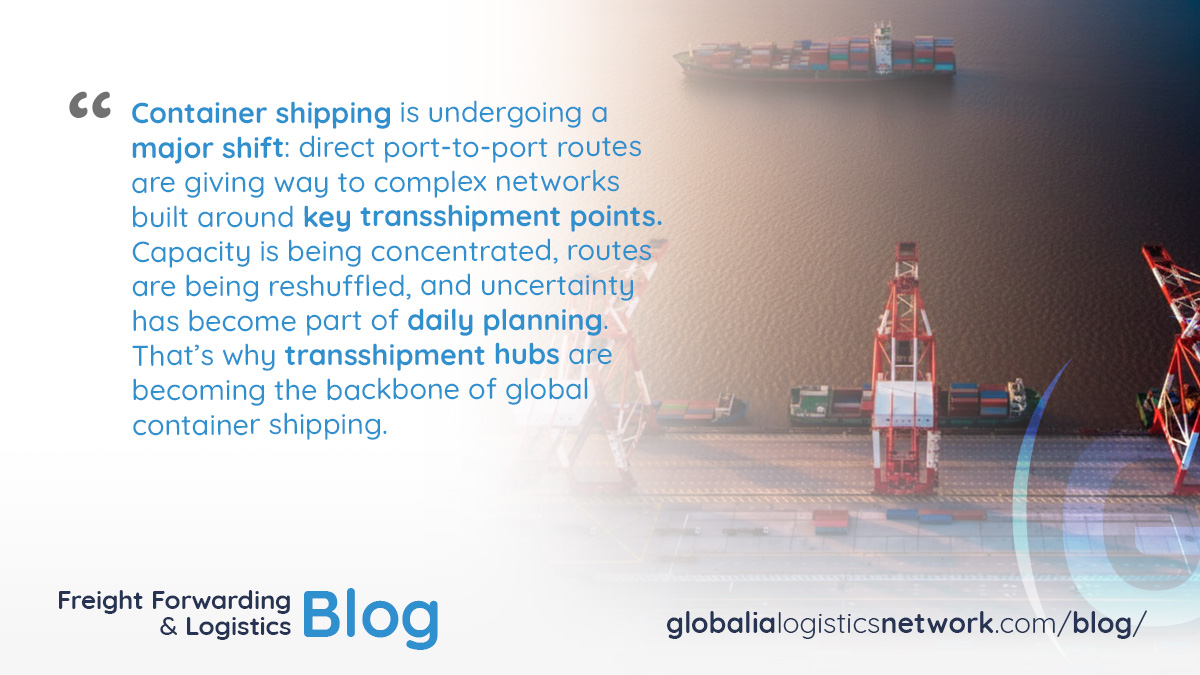
Container shipping is undergoing a major shift: direct port-to-port routes are giving way to complex networks built around key transshipment points. Capacity is being concentrated, routes are being reshuffled, and uncertainty has become part of daily planning. That’s why transshipment hubs 2026 are no longer just a supporting act. They’re becoming the backbone of how global container shipping actually works. For freight forwarders, this shift isn’t abstract. It affects transit times, pricing strategies, reliability, and how you explain routing decisions to customers. In today’s blog, we will discuss why transshipment hubs are growing, what drives the change, and how forwarders can leverage this structure to their advantage.
Why transshipment hubs 2026 are taking center stage
The big story behind transshipment hubs 2026 is concentration. Carriers are deploying fewer, larger vessels on mainline routes and relying more heavily on intermediate hubs to redistribute cargo. This aligns perfectly with the hub-and-spoke shipping model, where efficiency comes from scale at the core and flexibility at the edges. Global container shipping trends point in the same direction. Mega-vessels need deepwater ports, advanced cranes, and fast turnaround times. Not every port can handle that. Transshipment hubs fill the gap by acting as high-capacity sorting centers, moving boxes between long-haul services and regional feeders. Add port congestion 2026 to the mix, and the logic becomes even stronger. When direct ports clog up, hubs with optimized operations and multiple onward connections become pressure valves for the system.
Transshipment hubs 2026 and the rise of the hub-and-spoke model
The hub-and-spoke shipping model isn’t new, but 2026 is when it becomes unavoidable. Mega-alliances have reshaped service networks. Instead of offering dozens of direct port pairs, carriers now focus on a limited number of trunk routes between major transshipment ports. From there, cargo fans out through feeder services. The impact of mega-alliances on transshipment volumes is significant. As alliances rationalize capacity, transshipment hubs see consistent volume growth even when overall trade fluctuates. For forwarders, this means more routings involve at least one transshipment leg, whether the customer realizes it or not. What this really means is that understanding hub performance is now as important as understanding carriers themselves.
How Red Sea disruptions shifted cargo to transshipment hubs
Few events illustrate the importance of hubs better than recent Red Sea disruptions. As services were rerouted, suspended, or delayed, carriers leaned heavily on alternative transshipment points to maintain network flow. So how did Red Sea disruptions shift cargo to transshipment hubs? Cargo originally moving on direct Asia–Europe services was diverted to hubs in the Mediterranean, Gulf, and South Asia. From there, it was redistributed through secondary routes. This wasn’t just a stopgap. Many of these routings are becoming semi-permanent because they offer more flexibility under geopolitical stress. For forwarders, this reinforced a key lesson: transshipment hubs aren’t a weakness in the network. They’re what keeps cargo moving when direct routes break down.
Container transshipment growth and port specialization
Container transshipment growth isn’t evenly distributed. It’s concentrated in ports that invest heavily in speed, connectivity, and digital coordination. Major transshipment ports share a few common traits. They offer frequent sailings, multiple alliance calls, and fast feeder connections. They’re also less dependent on local import-export volumes, which makes them more resilient during demand swings. This is why the best transshipment hubs for Asian–European cargo continue to attract volume. They act as neutral exchange points where cargo can be reallocated quickly without waiting for direct services to reopen or normalize. For forwarders, specialization matters. Not every hub is good for every trade lane. Knowing which hubs excel at which flows becomes a real commercial advantage.
Transshipment hubs 2026 and congestion management
Port congestion 2026 is no longer just about queues at the gate. It’s about berth availability, crane productivity, labor stability, and weather resilience. Well-run transshipment hubs are investing aggressively in congestion mitigation. Automation, extended gate hours, predictive berth planning, and digital slot management are becoming standard. As a result, transshipment delays and reliability improvements in 2026 are happening at the same time. Delays still occur, but recovery is faster and more predictable. Forwarders benefit directly from this. When a delay happens at a hub with multiple onward options, rerouting is often possible within days instead of weeks. That flexibility is far harder to achieve on direct-only routings.
How AI routing is reshaping global transshipment patterns
One of the quieter shifts shaping global container shipping trends is artificial intelligence in routing decisions. How AI routing is reshaping global transshipment patterns comes down to data. Carriers and large forwarders now use AI-driven tools to analyze congestion levels, vessel delays, weather risks, and port performance in near real time. That data feeds into routing choices that favor certain hubs over others, sometimes on a weekly basis. For logistics companies, this means transshipment choices are becoming more dynamic. The “best” hub today might not be the best one next quarter. Staying informed isn’t optional anymore. It’s part of protecting service reliability and margins.
Hub-and-spoke logistics advantages for freight forwarding companies
From a forwarder’s perspective, the hub-and-spoke logistics advantages go beyond cost. First, flexibility. Transshipment hubs offer multiple carrier and feeder options, which helps when space is tight or schedules change.
Second, scalability. As volumes grow, hubs absorb increases more smoothly than smaller direct ports.
Third, negotiation leverage. When you understand transshipment networks, you can compare more routing options and negotiate better terms instead of being locked into a single direct service.
This is why many forwarders are actively redesigning their standard routings around transshipment hubs 2026, even for customers who previously insisted on direct calls.
The reliability question: delays versus resilience
Transshipment has always carried a reputation risk. More legs mean more chances for delay. That concern hasn’t disappeared, but the balance is shifting. In 2026, reliability is about choosing the right hub. Investments in digital coordination and feeder synchronization are improving predictability. In many cases, a well-chosen transshipment route is now more reliable than a congested direct port call. Forwarders who understand transshipment delays and reliability improvements in 2026 can explain this trade-off clearly to customers and set realistic expectations.
Final thoughts: why transshipment hubs will define 2026
The structure of global shipping is changing, whether the market likes it or not. Larger vessels, alliance-driven networks, geopolitical disruptions, and port congestion all point in the same direction. Transshipment hubs 2026 aren’t a workaround. They’re the system holding everything together. For freight forwarders, success in this environment depends on understanding which hubs perform, how alliances use them, and how technology is reshaping routing decisions. Those who treat transshipment as a strategic tool, rather than a necessary evil, will be better positioned to offer resilient, competitive solutions in one of the most complex shipping environments the industry has seen.