
For years, shippers routed around congestion by picking a different terminal in the same country. In 2026, they are picking a different country altogether, and Cai Mep-Thi Vai port is where a growing share of that traffic is landing. As Chinese gateways buckle under volume spikes and unpredictable dwell times, this deep-water port south of Ho Chi Minh City has moved from backup option to a serious first choice for shippers who need reliability more than they need familiarity. The shift did not happen overnight, but 2026 is the year it became undeniable. National container throughput across Vietnam’s seaport system hit 6.8 million TEUs in the first quarter alone, up 12.1 percent year on year, with vessel calls climbing sharply as carriers increasingly favor direct calls at deep-water terminals over congested transshipment hubs. Vietnam is no longer just the fallback plan. It is becoming the plan.
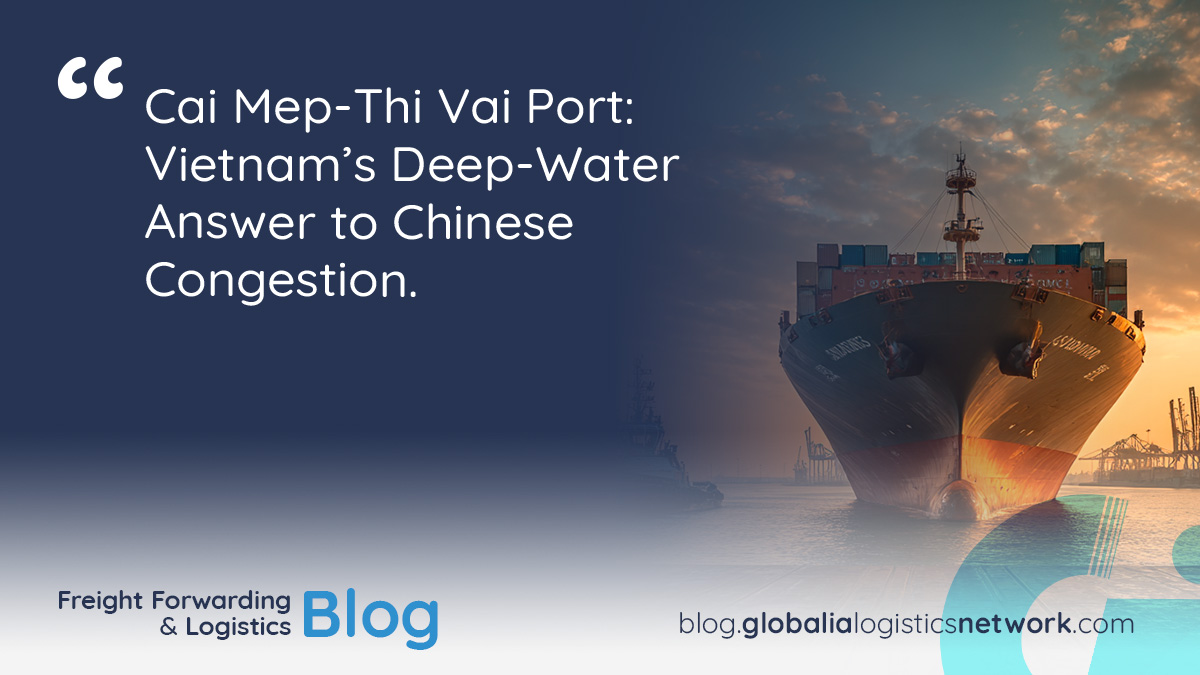
Why Cai Mep-Thi Vai Port Is Winning Cargo Away From China
The case for Cai Mep-Thi Vai Port rests on a simple operational fact: it can handle vessels up to 200,000 DWT and offer direct service to Europe and the US, bypassing the transshipment stop in Singapore that adds days to a routing through smaller Vietnamese terminals. Shipping from Cai Mep to Los Angeles runs a direct 21 to 23 days. Routing the same cargo through Ho Chi Minh City’s Cat Lai terminal, which requires a Singapore transshipment leg, stretches that same journey to 28 to 32 days. That is a full week of difference, and in a market where inventory holding costs and late-delivery penalties eat margin fast, a week matters.
This is precisely the calculation more shippers are making as China’s traditional gateways face recurring congestion and cost volatility. A China Plus One shipping strategy used to mean diversifying suppliers. Increasingly, it means diversifying ports too, and Southern Vietnam’s deep-water infrastructure is absorbing a meaningful share of that redirected volume. The Southeast Key Economic Region anchored by Cai Mep now handles close to half of Vietnam’s total cargo, and it is positioned to take on more as inland connectivity improves.
Infrastructure investment is closing gaps that once made this port a harder sell. The long-standing trucking bottleneck between Ho Chi Minh City industrial zones and Cai Mep, previously a real cost against the port’s transit-time advantage, is easing as ring roads and dedicated port rail links move toward completion. Long Thanh International Airport’s first phase, expected operational by late 2026, adds another layer of multimodal capacity to the same corridor. None of this happened by accident. Vietnam’s national port master plan explicitly targets Cai Mep-Thi Vai as one of its core international gateway ports, with container throughput capacity nationally projected to reach 46 to 54 million TEUs by 2030.
Two Shipments That Show the Difference
Take an electronics manufacturer in Dong Nai province shipping finished goods to the US West Coast. Routing through Cat Lai means fighting through a terminal handling over 22,000 vehicles a day, frequent multi-hour truck delays, and a mandatory Singapore transshipment stop. Routing the same shipment through Cai Mep-Thi Vai port cuts total transit to roughly three weeks, avoids the transshipment leg entirely, and gives the shipper a far more predictable delivery window for retail replenishment schedules that do not forgive a week-late delivery.
Now consider an apparel exporter weighing options during a period of Chinese gateway congestion, when carriers are absorbing longer dwell times and shippers are eating unpredictable demurrage costs. Moving sourcing or at least final assembly and export routing through Southern Vietnam and out through Cai Mep gives that exporter access to weekly ultra-large vessel calls under the Gemini Cooperation alliance, guaranteeing scheduled capacity rather than competing for space on overburdened Chinese strings. For a shipper trying to hit a fixed seasonal launch date, that scheduling certainty is worth more than a marginally cheaper freight rate on a route that might not run on time.
The Trade-Offs Shippers Still Need to Plan For
Cai Mep-Thi Vai port is not a frictionless alternative, and treating it as one is how forwarders get caught out. Inland trucking distance from Ho Chi Minh City industrial zones runs 50 to 70 kilometers, longer than the short hop to Cat Lai, and that distance still carries real cost when road conditions or toll fees spike. The port cluster has also historically lacked a fully built-out logistics service ecosystem around it, meaning fewer specialized cargo handling and inspection facilities directly on site compared to more established hubs.
These are gaps that are closing, not gaps that have closed. Shippers moving volume through Vietnam container terminal capacity in 2026 should factor in current inland transport realities rather than the finished-infrastructure vision still a few years out. The port’s own utilization data supports this transition story rather than a completed one: Cai Mep has historically run at a fraction of its total capacity even as throughput accelerates, which points to real headroom for continued growth rather than a terminal already straining at its limits.
Reading the Bigger Picture
Vietnam-US trade lane growth, sustained Southeast Asia freight rerouting, and Vietnam’s own government targets all point in the same direction. Ho Chi Minh City port congestion at Cat Lai is not disappearing, and Chinese gateway pressure is not either. Every quarter that pressure persists, more volume shifts toward ports built to handle it without the same bottlenecks, and Cai Mep-Thi Vai port sits at the center of that shift for Southern Vietnam’s export economy.
For shippers and forwarders building routing strategy for the next several years, the question is no longer whether Vietnam’s deep-water ports deserve a place in the network. It is how quickly to move volume there before the capacity advantage narrows as more of the market catches on to the same math.