

Anyone moving cargo around the Gulf this year has felt the strain on the roads. With the Strait of Hormuz disrupted, shippers have turned to Omani ports and long trucking legs into the UAE, and every extra day at a border crossing shows up in somebody’s costs. Beneath that short-term scramble, a longer-term answer is being built in the Hajar mountains: a cross-border railway that will tie the Omani port of Sohar to the UAE’s national rail network. It is not running yet, but forwarders who plan ahead will want to understand it now.
Hafeet Rail at a Glance: The Project Behind the Headlines
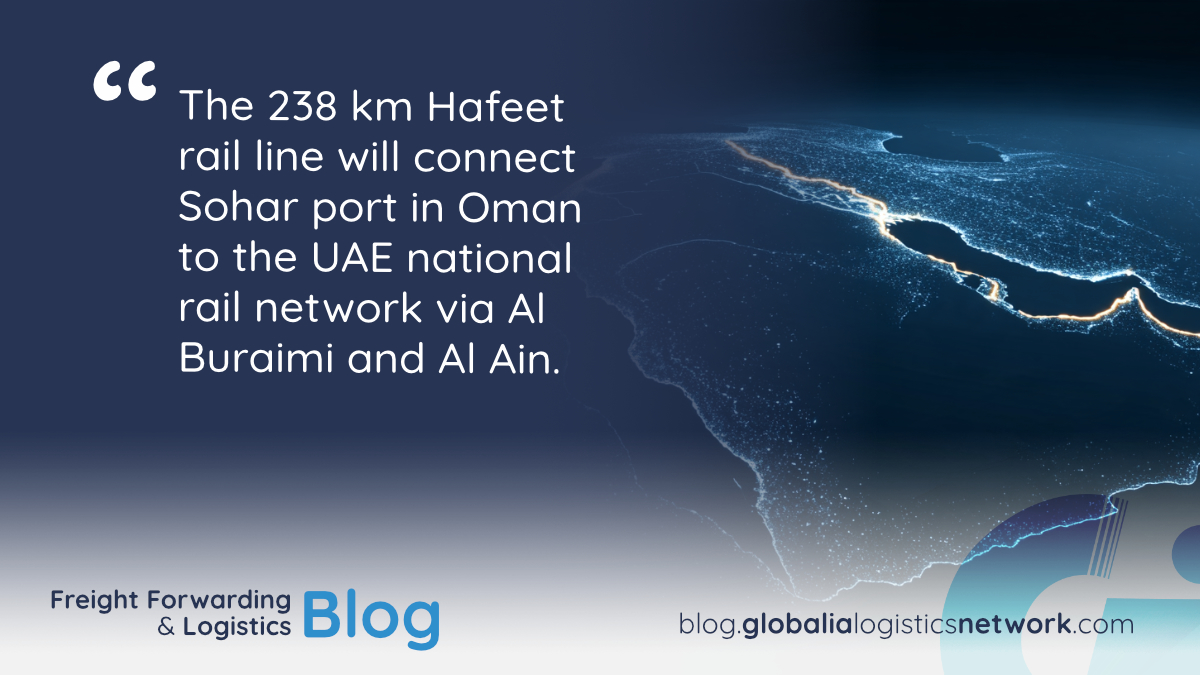
Hafeet railway is a joint venture between Etihad Rail, Oman Rail and Mubadala Investment Company, and its backers describe it as the first railway of its kind to connect two Gulf states. The key facts are below.
| Item | Detail |
|---|---|
| Route | Sohar (Oman) to the UAE national rail network, via Al Buraimi and Al Ain |
| Length | 238 km |
| Value | About $2.5bn, with $1.5bn in project financing |
| Freight trains | Up to 120 km/h; more than 15,000 tonnes, or roughly 270 standard containers, per train |
| Target cargo | Mining, steel, petrochemicals, agriculture, food, retail and e-commerce |
| Progress | About 40% complete in the latest reported update |
| Trial operations | Expected in Q4 2027 |
The engineering is substantial. The line includes about 2.5 km of tunnels and dozens of bridges, viaducts and underpasses as it crosses the Hajar mountains.
Why the timing matters
The rail link arrives against a backdrop of improvisation. Since Hormuz was disrupted, Sohar, Duqm and Salalah have become entry points for cargo that is then trucked into the UAE. Land bridges are moving only 20–30% of the region’s trade, according to Xeneta data cited by The National, well short of what used to pass through the strait. One Omani heavy-lift executive told AGBI that the longer land leg adds about 20% to costs.
Trucks are flexible, but they are also expensive, and they depend on border crossings that can clog. Hafeet Rail will not solve today’s bottlenecks, because it will not carry commercial cargo before trial operations begin in late 2027. What it offers is a structural alternative: a high-capacity route that does not rely on the strait or on endless convoys of trucks.
What it could change for freight forwarders
Capacity is the first thing. A single freight train is designed to carry roughly 270 standard containers, a volume that would otherwise need a long convoy of trucks. Rail can also offer more predictable schedules than road, although that will depend on how services are timetabled. If Hafeet Rail delivers on its design, Sohar could become a genuine intermodal node, with a port, Oman’s largest free trade zone and a direct rail connection into the UAE network in one place.
There are early commercial signals. In 2025, the project signed a preliminary agreement with Noatum Logistics, part of AD Ports Group, for a dedicated Abu Dhabi to Sohar rail freight service. The target industries, from steel and petrochemicals to food, retail and e-commerce, suggest a line meant for both bulk and containerised cargo. For forwarders, that points to new options for consolidation, multimodal quoting and cargo that currently moves by road or on longer sea routes.
What we do not know yet
Several practical questions remain unanswered in the public information available:
- Freight tariffs and how services will be priced
- Weekly capacity and train frequency
- Freight transit times between Sohar and UAE destinations
- Customs and documentation procedures at the Oman-UAE rail crossing
- The commercial opening date, since only trial operations are scheduled, for the final quarter of 2027, with passenger services to follow once commercial operations begin
Until these details are published, any claims about savings or speed are speculation. Forwarders should treat the project as a planning scenario for now, not yet a booking option.
How forwarders can prepare
Preparation does not require waiting for the first train. Forwarders tracking Hafeet Rail should start by mapping which of their customers’ cargo flows between Oman and the UAE could suit rail, such as bulk commodities, building materials, food and containerised goods. They can then talk to partners at Sohar and in Abu Dhabi and Al Ain about handling, storage and last-mile delivery, and review how their quoting processes handle journeys that combine sea, rail and road. Finally, they should watch for customs announcements, because the documentation for a cross-border rail service will shape how attractive it proves in practice.
Why Omani forwarders should consider joining an international network
A rail corridor changes who needs to talk to whom. Cargo arriving at Sohar by sea, moving by rail into the UAE and finishing its journey by truck involves at least three handovers, and each depends on partners who trust one another’s documents, timing and standards. For forwarders based in Oman, joining an international network such as Globalia Logistics Network offers a practical way to prepare. Membership can connect an Omani company with vetted, independent partners across 182 cities around the globe, giving it a ready channel for enquiries from overseas forwarders who need a reliable local contact at Sohar. It also provides a shared pool of experience on customs, routing and compliance, which will be valuable as a new corridor finds its rules. As Hafeet Rail moves from construction to operation, the forwarders with established partnerships at both ends of the line will be best placed to win the first cargo.
Looking ahead
The Oman-UAE rail link is still some way from its first commercial train, but the direction of travel is clear: Gulf freight is looking for routes that are less exposed to a single chokepoint. Forwarders who understand the project now, and build the partnerships to use it, will be ready when the first container trains leave Sohar.