

Being landlocked shapes how a logistics market thinks, plans, and operates. In Kampala, that reality has led to a system built on coordination rather than proximity to a port. There’s no coastline to rely on. No direct access to ocean freight. Yet cargo moves in and out of Uganda every day, connecting businesses to global markets. The difference lies in how those connections are built and how efficiently they are managed.
Operating Without Direct Port Access
For Kampala, international trade begins far from the city itself. Imports and exports depend on coastal gateways located in neighboring countries. Cargo arrives at seaports, then travels inland across hundreds of kilometers before reaching its destination. This creates a logistics model where inland transport plays as much of a role as ocean freight. Instead of a single handoff from vessel to truck, shipments pass through multiple stages:
- Ocean freight to an East African port
- Port handling and customs clearance
- Inland transport by road or rail
- Final delivery into Kampala and the surrounding regions
This layered structure requires careful planning at every step. Timing, coordination, and communication all shape the outcome.
Dependence on Regional Gateways
Two ports form the backbone of Uganda’s international trade: the Port of Mombasa in Kenya and the Port of Dar es Salaam in Tanzania. Each offers a distinct route into Kampala.
The Northern Corridor (via Mombasa)
This is the most commonly used route. Cargo arrives at Mombasa and moves inland through Kenya, typically entering Uganda via border points such as Malaba or Busia. The corridor benefits from relatively developed infrastructure and established logistics networks.
The Central Corridor (via Dar es Salaam)
This route passes through Tanzania before reaching Uganda. It often serves as an alternative when congestion or delays affect the northern route, offering forwarders additional flexibility in planning shipments.
For freight forwarders, choosing between these corridors is rarely a fixed decision. It depends on cargo type, timelines, cost considerations, and current conditions along each route.
What This Means for Transit Times
Distance alone does not define transit time in a landlocked environment. A shipment moving to Kampala involves multiple checkpoints, port operations, customs clearance, border crossings, and inland transport. Each stage contributes to the overall timeline. The route via Mombasa generally offers faster transit under stable conditions, thanks to its more established infrastructure. However, factors like port congestion or border delays can extend delivery schedules.
The Dar es Salaam route, while sometimes longer in distance, provides an alternative when the northern corridor faces disruptions. This creates a balance where forwarders can adapt based on real-time conditions. The implication is that transit time becomes a variable rather than a constant. Planning needs to account for that variability, with buffers and contingency options built into the process.
Cost Implications in a Landlocked Market
Operating without direct port access adds layers of cost that coastal markets do not experience in the same way. Inland transport represents a significant portion of the total logistics expense. Fuel costs, road conditions, and distance all influence pricing. Border procedures and administrative processes also contribute to overall costs. At the same time, economies of scale play a role. Consolidation strategies, efficient routing, and strong carrier relationships help optimize expenses. For forwarders, cost management in Kampala is less about finding the cheapest route and more about balancing reliability with efficiency. A slightly higher cost on one corridor may result in better predictability and fewer delays, which ultimately benefits the supply chain.
Planning for Complexity
Logistics in Kampala rewards preparation. Forwarders need to think beyond standard port operations and focus on the entire journey. That includes:
Route selection
Choosing between Mombasa and Dar es Salaam based on current conditions and shipment priorities.
Documentation and customs coordination
Ensuring all paperwork aligns across multiple jurisdictions to avoid delays at borders.
Carrier and partner selection
Working with reliable transport providers who understand regional dynamics.
Contingency planning
Preparing alternative routes and timelines to handle unexpected disruptions.
This level of planning transforms complexity into manageable operations. It also creates opportunities for forwarders who understand how to navigate the system effectively.
Inland Infrastructure and Distribution
Kampala’s role as a logistics hub extends beyond receiving cargo. The city acts as a distribution center for goods moving across Uganda and into neighboring markets. Inland container depots and warehousing facilities support storage, consolidation, and redistribution. From Kampala, cargo can move onward to countries such as Rwanda, South Sudan, and the Democratic Republic of Congo. This expands its reach beyond a national hub into a regional logistics center. What emerges is a network where inland connectivity replaces coastal access as the defining feature.
The Importance of Strong Partnerships
In a logistics chain that spans multiple countries and transport modes, partnerships become essential. Each shipment involves coordination between port operators, customs authorities, transport providers, and local agents. The quality of these relationships directly affects efficiency. For freight forwarders, building a reliable network of partners ensures smoother operations and better control over the supply chain.
How Globalia Strengthens Operations in Kampala
This is where joining a global freight network becomes a practical advantage. For forwarders based in Kampala, connecting with trusted partners in Kenya, Tanzania, and beyond is a key part of daily operations. Each shipment depends on seamless coordination across borders.
By joining Globalia Logistics Network, forwarders gain access to a global ecosystem of carefully vetted agents. With nearly 200 members across more than 130 countries, the network provides coverage that supports complex, multi-country logistics chains. For Kampala-based operators, this translates into:
- Reliable partners around key ports
- Strong connections across key trade routes into Europe, Asia, and the Middle East
- Increased visibility within the network, supported by exclusive representation per location
- Access to new business opportunities through member collaboration
The benefit is not just reach, it’s consistency. Each stage of the shipment is handled by partners who understand the expectations and standards of the network.
A Hub Defined by Connectivity
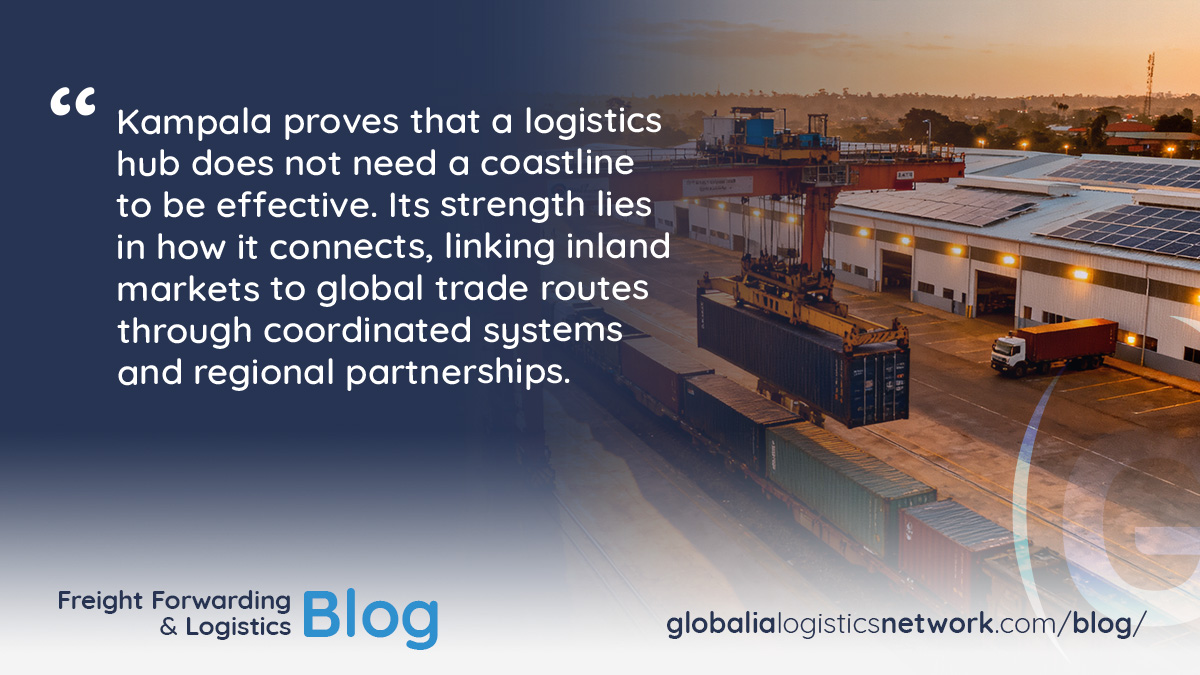
Kampala proves that a logistics hub does not need a coastline to be effective. Its strength lies in how it connects, linking inland markets to global trade routes through coordinated systems and regional partnerships. Cargo moves across borders, adapts to different routes, and reaches destinations through a network that values planning and flexibility. For freight forwarders, this creates a working environment where expertise matters. Understanding the corridors, managing timelines, and building strong partnerships all contribute to successful operations. And with the support of a global network like Globalia, that expertise gains a wider reach, turning a landlocked challenge into a connected opportunity.