
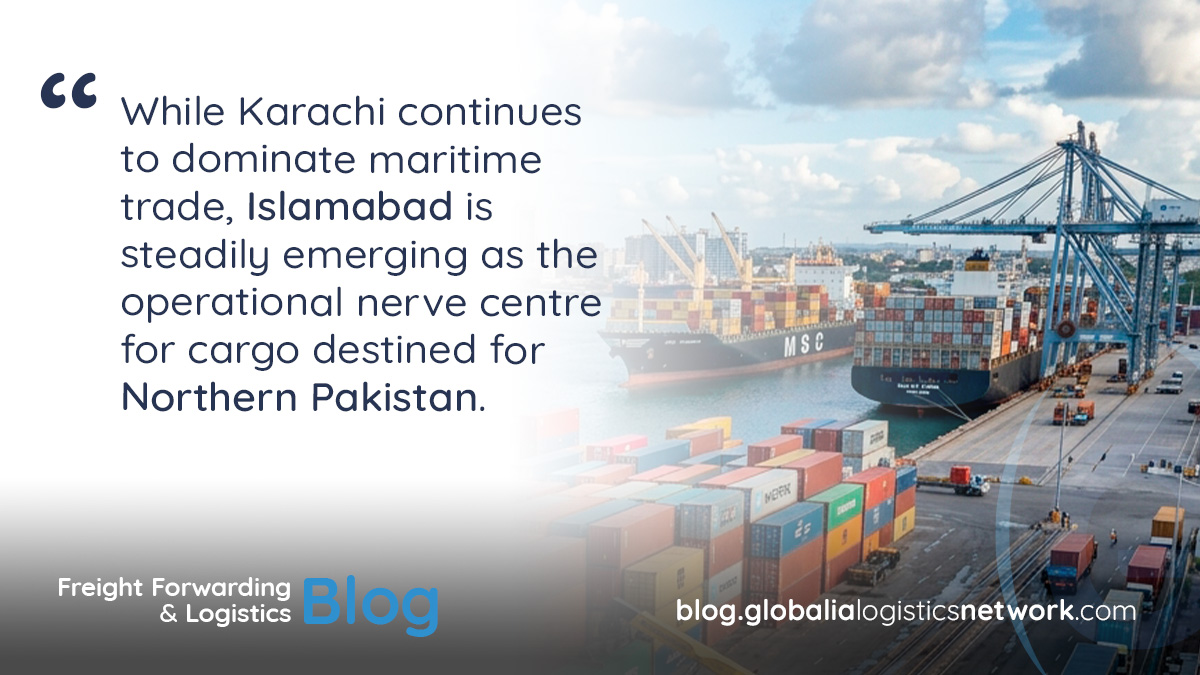
When people think about logistics in Pakistan, their minds almost immediately turn to Karachi. As the country’s largest seaport city, Karachi undoubtedly remains the primary entry point for international cargo. However, once goods have entered the country, a different city increasingly takes centre stage in coordinating, distributing, and managing freight movements across some of Pakistan’s most strategically important regions. That city is Islamabad. The Pakistan logistics industry has undergone significant transformation over the last decade, driven by infrastructure investments, regional trade initiatives, and growing demand for efficient supply chain solutions. While Karachi continues to dominate maritime trade, Islamabad is steadily emerging as the operational nerve centre for cargo destined for Northern Pakistan. Its strategic location, modern infrastructure, and proximity to key economic corridors make the capital city an indispensable link in the country’s evolving logistics landscape.
Islamabad’s Strategic Position in the Pakistan Logistics Industry
Unlike Karachi, which serves primarily as a maritime gateway, Islamabad functions as a logistics command centre. The city sits at the crossroads of major transport routes connecting Northern Punjab, Khyber Pakhtunkhwa, Gilgit-Baltistan, and Azad Jammu and Kashmir. For freight forwarders, this geographic advantage is highly significant. Cargo arriving through Pakistan’s ports or airports is often routed through Islamabad before reaching its final destination in northern regions. As a result, the city has become a critical coordination point for domestic transportation, warehousing, customs support, and last-mile distribution. This role has become increasingly important as businesses seek faster and more reliable access to markets beyond Pakistan’s traditional commercial centres.
A Gateway to Northern Pakistan
One of Islamabad’s greatest strengths lies in its connectivity to regions that are becoming increasingly important for trade, tourism, infrastructure development, and industrial growth. Khyber Pakhtunkhwa continues to attract investment in manufacturing, agriculture, and energy projects. Gilgit-Baltistan has gained strategic relevance due to its location along major regional trade corridors. Meanwhile, Azad Jammu and Kashmir and northern Punjab are witnessing growing demand for consumer goods, construction materials, and industrial equipment. For logistics providers, serving these regions requires more than simply transporting cargo from point A to point B. It requires careful route planning, coordination with local transport networks, and an understanding of seasonal challenges that can affect transit times. Islamabad offers an ideal base from which these operations can be managed efficiently.
Infrastructure Supporting Growth
The city’s growing importance is supported by significant infrastructure improvements. Modern motorway networks provide direct access to major commercial and industrial centres across the country. Improved road connectivity has reduced transit times and enhanced reliability for domestic freight movements. The presence of Islamabad International Airport has further strengthened the city’s logistics capabilities. While not competing with Karachi in terms of volume, the airport plays an important role in handling time-sensitive cargo, including pharmaceuticals, telecommunications equipment, electronics, and project-related shipments. Combined with expanding warehousing facilities and transportation services, these developments have reinforced Islamabad’s position within the Pakistan logistics industry.
The Islamabad-Rawalpindi Advantage
Another factor contributing to Islamabad’s logistics importance is its close integration with Rawalpindi. Often referred to as Pakistan’s twin cities, Islamabad and Rawalpindi function as a single economic and logistics ecosystem. Many logistics operators maintain offices, warehouses, and distribution facilities across both cities. This provides access to a larger labour pool, transportation infrastructure, and commercial customer base. The combined strengths of the Islamabad-Rawalpindi corridor enable freight forwarders to offer more flexible and efficient solutions while serving clients across Northern Pakistan.
Supporting Regional Trade Opportunities
Islamabad’s importance extends beyond domestic logistics. The city is increasingly well-positioned to benefit from Pakistan’s expanding trade links with neighbouring countries and Central Asia. As regional connectivity initiatives continue to develop, Northern Pakistan is expected to play a greater role in facilitating trade flows between South Asia, Central Asia, and Western China. For logistics companies, this presents significant opportunities. Businesses capable of managing cargo movements through Islamabad can potentially benefit from growing cross-border trade, infrastructure projects, and investment activities throughout the region. This evolving role further strengthens Islamabad’s relevance within the Pakistan logistics industry and highlights its potential as a future regional logistics hub.
Why Joining Globalia Logistics Network Can Benefit Islamabad-Based Logistics Companies
As Islamabad continues to strengthen its position as a strategic logistics centre, local freight forwarders face both opportunities and challenges. While demand for logistics services is growing, competition is also becoming increasingly global. Customers expect seamless international solutions, wider market reach, and reliable partners across multiple countries.
This is where joining Globalia Logistics Network can provide a significant advantage.
Globalia Logistics Network connects independent freight forwarders worldwide through a carefully selected network of trusted logistics companies. For a logistics company based in Islamabad, membership offers immediate access to reliable partners in hundreds of key commercial centres worldwide. This enables members to offer comprehensive international freight solutions while maintaining their independence.
The network’s Annual Meetings create valuable opportunities for members to build face-to-face relationships with overseas partners, generating new business opportunities and strengthening existing collaborations. In an industry where trust remains one of the most important factors in choosing a logistics partner, these personal connections can be invaluable.
In addition, Globalia provides members with marketing support, industry visibility, digital promotion opportunities, and access to a secure payment protection programme. These resources help independent freight forwarders compete more effectively with larger multinational companies.
For Islamabad-based logistics providers seeking to expand their international reach, attract new overseas partners, and participate more actively in global trade flows, membership in Globalia Logistics Network can serve as a powerful catalyst for growth. As Islamabad’s role in regional logistics continues to expand, being part of a strong global network can help local companies convert emerging opportunities into long-term business success.
Looking Ahead
The future of logistics in Pakistan is no longer centred exclusively around its seaports. As supply chains become more complex and regional trade opportunities continue to evolve, operational hubs within the country are becoming increasingly important.
Islamabad’s strategic location, connectivity, infrastructure, and access to Northern Pakistan position it as one of the country’s most important logistics centres. From coordinating domestic distribution to supporting regional trade and infrastructure projects, the city is playing a growing role in shaping the future of the Pakistan logistics industry.
For freight forwarders and logistics providers looking to capitalise on new opportunities, Islamabad is no longer simply the nation’s capital. It is rapidly becoming one of Pakistan’s most influential logistics gateways.
Related posts:

COVID-19 will usher in an era of digital transformation in the transportation and logistics industry

Amazon's $1 billion investment in logistics technology and the takeaway for independent freight forw...