

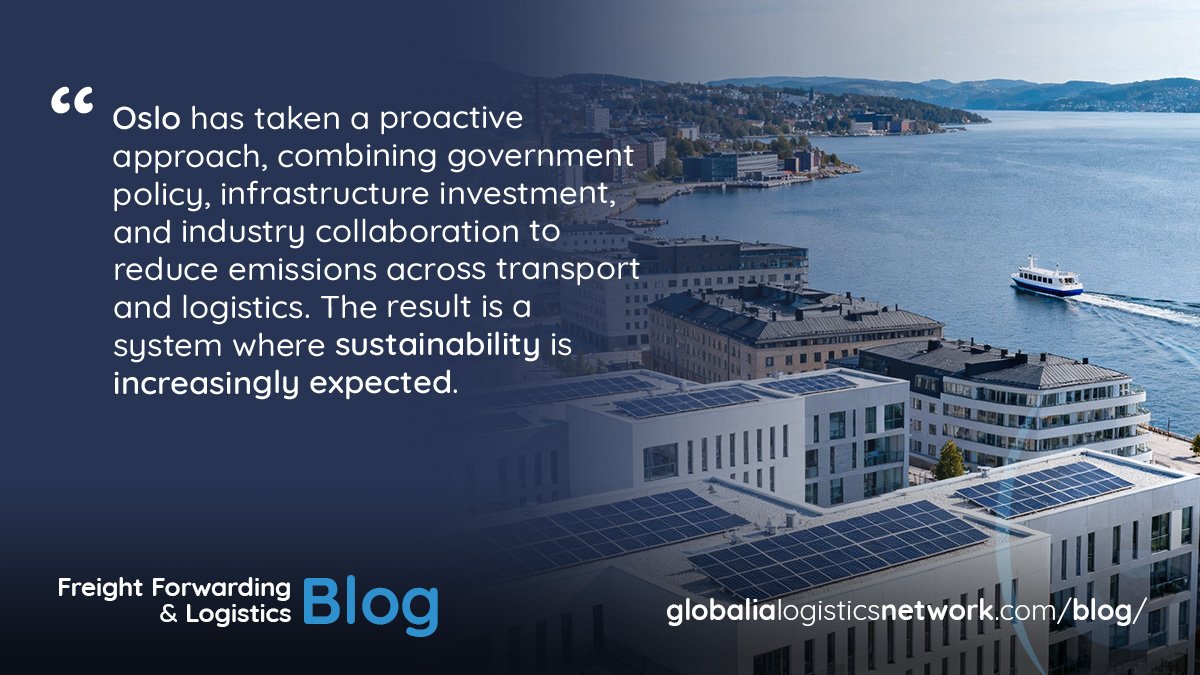
The global push toward cleaner supply chains is happening on the ground, and few cities illustrate this better than Oslo. For freight forwarders and logistics providers, the trend of zero-emission logistics in Oslo is quickly becoming a real-world model of how urban freight can evolve without compromising efficiency. Norway’s capital has taken a proactive approach, combining government policy, infrastructure investment, and industry collaboration to reduce emissions across transport and logistics. The result is a system where sustainability is not just encouraged but increasingly expected. For logistics companies, Oslo offers a glimpse into the future of freight.
Zero Emission Logistics Oslo: A Policy-Driven Transformation
The rise of zero emission logistics Oslo is deeply rooted in policy. Norwegian authorities have set ambitious climate targets, including a goal to significantly reduce greenhouse gas emissions by 2030 and transition toward zero-emission transport systems. Oslo has introduced low-emission zones, incentives for electric vehicles, and strict environmental standards for urban deliveries. Public procurement policies also play a role, requiring suppliers to adopt eco-friendly freight forwarding practices to qualify for contracts.
These measures are part of broader zero-emission logistics initiatives in Norway, which aim to decarbonize not just passenger transport but also freight movement. For logistics companies, this creates both pressure and opportunity. Compliance is essential, but those who adapt early gain a competitive edge.
Oslo Sustainable Transport Logistics: Infrastructure That Supports Change
Policies alone don’t drive transformation, execution does. Oslo has backed its ambitions with strong infrastructure investments, making Oslo sustainable transport logistics a practical reality. The city has developed one of the world’s most advanced electric vehicle ecosystems. This includes widespread charging infrastructure, support for electric vans and trucks, and pilot projects involving electric construction machinery and delivery fleets. Urban consolidation centers have also been introduced to optimize last-mile delivery. These hubs allow goods to be grouped and delivered using zero-emission vehicles, reducing congestion and emissions at the same time. This approach is a key example of green supply chain logistics in action. For freight forwarders, this infrastructure makes it easier to adopt zero-emission freight transport without sacrificing reliability or speed.
Sustainable Logistics Solutions Norway: Industry Adoption and Innovation
The success of sustainable logistics solutions in Norway lies in how quickly the private sector has responded. Major logistics providers and local forwarders are actively investing in electric fleets, alternative fuels, and digital tools to optimize routes. Companies are experimenting with electric trucks, hydrogen-powered vehicles, and even autonomous delivery solutions. These innovations are not just pilot projects, they are becoming part of everyday operations. This shift highlights how Oslo is leading zero emission logistics through collaboration between government and industry. Forwarders are not just reacting to regulations; they are actively shaping the transition. For businesses focused on green logistics freight forwarding, Oslo offers a clear roadmap for integrating sustainability into core operations.
Zero Emission Logistics Europe: Oslo as a Benchmark
Across zero emission logistics in Europe, cities are exploring ways to reduce the environmental impact of freight. However, Oslo stands out for the speed and scale of its implementation. While many European cities are still in the planning phase, Oslo has already rolled out practical solutions. Its success is influencing policy discussions and logistics strategies across the region.
This positions Oslo as a benchmark within logistics decarbonization Europe. Freight forwarders operating internationally can use the Oslo model to anticipate future regulations and adapt their operations accordingly. For companies involved in sustainable logistics Europe, understanding Oslo’s approach is becoming increasingly important.
Green Logistics: What It Means in Practice
For freight forwarders, the shift toward sustainability is not just about vehicles, it’s about rethinking the entire supply chain. Green logistics freight forwarding involves optimizing routes, reducing empty miles, and choosing environmentally friendly transport modes. In Oslo, forwarders are integrating digital tools that improve efficiency and reduce emissions. Real-time tracking, route optimization software, and data-driven decision-making are all part of the equation. This also ties into eco friendly freight forwarding, where companies focus on minimizing their environmental footprint while maintaining service quality. Clients are increasingly demanding these solutions, especially in industries with strong sustainability commitments. The move toward zero-emission logistics is accelerating this trend, pushing forwarders to innovate and adapt.
Shipping Norway Europe: A Greener Trade Corridor
Oslo’s influence extends beyond city limits. The shift toward sustainable logistics is shaping freight routes, encouraging the adoption of cleaner transport methods across the region. Ports are investing in shore power, reducing emissions from vessels at berth. There is also growing interest in alternative fuels such as LNG, hydrogen, and ammonia for maritime transport. These developments are part of a broader push toward sustainable logistics, where environmental considerations are becoming central to trade and transport decisions. For freight forwarders, this means aligning operations with evolving standards and exploring new ways to reduce emissions across international shipments.
Challenges in Logistics Decarbonization Europe
Despite its progress, Oslo’s journey highlights the challenges of logistics decarbonization Europe. Transitioning to zero-emission systems requires significant investment in vehicles, infrastructure, and technology. There are also operational challenges. Electric vehicles have range limitations, and charging infrastructure, while advanced, still requires careful planning. For forwarders, balancing cost, efficiency, and sustainability can be complex. However, these challenges are part of the transition. Oslo’s experience shows that with the right policies and industry commitment, they can be managed effectively.
How Globalia Logistics Network Supports Oslo-Based Forwarders
Freight forwarders in Oslo looking to stay competitive in an increasingly sustainability-driven market can significantly strengthen their capabilities by joining a well-established international logistics network like Globalia Logistics Network. The value goes far beyond simple visibility. Membership provides a global platform to enhance brand recognition, collaborate with reliable partners, and access consistent business opportunities across key trade lanes. Here’s how Globalia supports forwarders in Oslo:
Territorial Exclusivity
Globalia maintains a strict territorial exclusivity policy, which ensures that forwarders in Oslo are not competing with multiple companies from the same location within the network. The result is stronger visibility and a higher likelihood of receiving shipment inquiries from international partners.
Build a Strong Global Presence
Globalia connects freight forwarders across a wide network of strategic locations worldwide. This allows members to extend their reach far beyond their domestic market. Instead of relying on unknown agents, members collaborate with carefully vetted partners who meet strict quality standards, ensuring reliability and consistency across shipments.
Access to New Project Opportunities
One of the biggest advantages of joining Globalia is the steady flow of business opportunities. Members actively cooperate and refer shipments within the network, creating a collaborative environment where everyone benefits.
Meet Partners Face-to-Face at Annual Meetings
Globalia’s Annual Meeting is a cornerstone of the network. It brings together freight forwarders from around the world for pre-scheduled one-to-one meetings, allowing members to build strong, long-term relationships. For Oslo-based companies, this is an opportunity to connect directly with partners in key markets, discuss collaborations, and strengthen trust. These in-person interactions often translate into smoother operations and increased business.
The Road Ahead
Oslo’s leadership in sustainable logistics is a long-term transformation. The city has demonstrated that zero emission logistics Oslo is achievable through a combination of policy, infrastructure, and industry collaboration. Sustainability is becoming a core requirement, not a differentiator. Companies that embrace this shift will be better positioned to meet client expectations, comply with regulations, and remain competitive in a changing market. Understanding how Oslo is leading zero emission logistics offers valuable insights for forwarders operating across Europe and beyond. It shows that the future of logistics is not just about moving goods efficiently, but doing so responsibly. As the industry continues to evolve, Oslo stands as a powerful example of what’s possible when ambition meets execution.