

Global manufacturing is entering a new phase shaped by supply chain diversification, regional sourcing strategies, and shifting trade dynamics between Europe and Asia. Companies across industries are reevaluating where products are manufactured, how cargo moves across borders, and which logistics hubs can support faster and more resilient supply chains. In this changing environment, manufacturing logistics Bursa operations are gaining growing attention from freight forwarders, exporters, and industrial manufacturers alike.
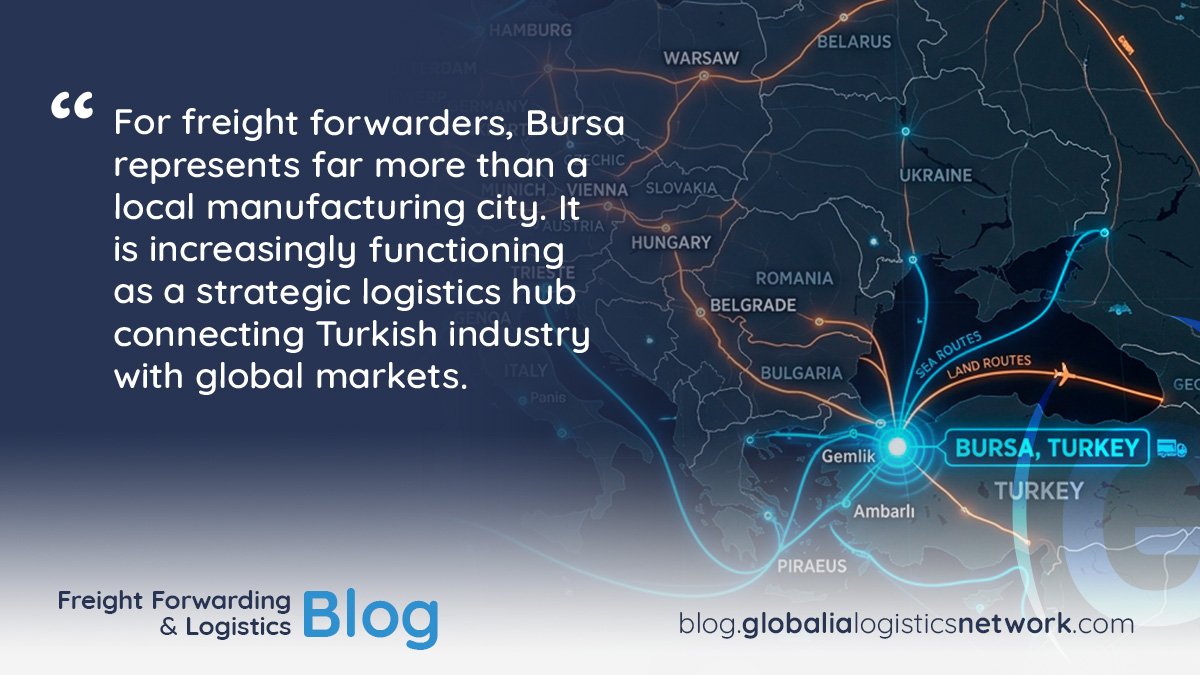
Located in northwestern Turkey within the highly industrialized Marmara region, Bursa has become one of the country’s most important manufacturing and export centers. The city combines industrial strength, strong transportation connectivity, proximity to Europe, and access to maritime gateways that support regional and international cargo movement. For freight forwarders, Bursa represents far more than a local manufacturing city. It is increasingly functioning as a strategic logistics hub connecting Turkish industry with global markets.
What makes Bursa especially important today is the way global supply chains are evolving. European companies are diversifying sourcing strategies, nearshoring production, and strengthening regional supplier networks closer to key consumer markets. Turkey’s geographic position between Europe, Asia, and the Middle East places the country in a highly advantageous position within this transformation, and Bursa stands at the center of much of that industrial activity.
Why Manufacturing Continues to Drive Bursa’s Economic Importance
Bursa has long been associated with Turkish manufacturing. Over the decades, the city developed into one of the country’s largest industrial bases, supported by automotive production, textile manufacturing, machinery exports, metal processing, and industrial equipment manufacturing. Today, Bursa contributes significantly to Turkey’s export economy and remains one of the country’s leading industrial regions.
The automotive sector plays an especially important role. Bursa hosts major vehicle manufacturing operations and extensive supplier ecosystems supporting both domestic production and international exports. Automotive components, machinery, engineered materials, and industrial parts move continuously between factories, warehouses, ports, and overseas markets.
This concentration of industrial activity naturally creates strong logistics demand. Manufacturing supply chains require highly coordinated transportation planning involving inbound raw materials, production equipment, warehouse operations, export cargo movement, customs coordination, and multimodal transportation networks. Freight forwarders operating in Bursa increasingly manage highly integrated industrial logistics operations that extend across Europe, Asia, and beyond.
Textile manufacturing also contributes substantially to regional cargo flows. Turkey remains one of Europe’s major textile and apparel suppliers, and Bursa continues to serve as an important production center within this industry. Textile exports require efficient transportation coordination, flexible distribution planning, and reliable international shipping connections to support constantly evolving retail supply chains. As manufacturing activity expands and diversifies, logistics operations surrounding Bursa are becoming increasingly sophisticated and internationally connected.
Manufacturing Logistics Bursa and Turkey’s Strategic Geographic Position
Turkey’s geographic position creates enormous advantages for international logistics operations. The country connects Europe, Asia, and the Middle East while providing direct access to major maritime trade routes through the Mediterranean, Black Sea, and Aegean regions. Bursa benefits directly from this strategic positioning. Located near Istanbul and connected to the broader Marmara industrial corridor, the city supports cargo movement between Turkish manufacturing centers and key European markets. Freight moving through Bursa can efficiently access Germany, Italy, France, Eastern Europe, and other regional destinations through well-established trucking and maritime networks.
Road freight remains especially important for Turkish exports. Trucks regularly move industrial cargo between Bursa and major European markets through cross-border corridors connecting Turkey with Southeastern and Central Europe. This strong trucking infrastructure supports just-in-time manufacturing operations and flexible regional distribution strategies.
The city also benefits from proximity to important port infrastructure. Nearby ports within the Marmara region support containerized cargo, automotive exports, industrial freight, and project shipments moving between Turkey and global markets. Maritime connectivity remains critical for Turkish manufacturers exporting products across Europe, North America, Asia, and the Middle East.
Manufacturing logistics Bursa operations increasingly depend on this combination of industrial concentration and transportation access. Manufacturers require supply chains capable of balancing production schedules, transportation flexibility, inventory management, and export coordination simultaneously. Freight forwarders managing these operations play a central role in maintaining operational continuity across highly interconnected industrial networks.
Nearshoring Trends Are Strengthening Turkey’s Logistics Role
One of the most important developments influencing global manufacturing today is nearshoring. European businesses are increasingly seeking production locations closer to their primary consumer markets in order to reduce supply chain complexity, shorten transit times, and improve operational resilience. Turkey has emerged as one of the major beneficiaries of this trend. Compared to longer-distance sourcing routes from East Asia, Turkey offers shorter transportation timelines, strong manufacturing expertise, and highly developed industrial infrastructure. This makes the country increasingly attractive for sectors such as automotive, textiles, machinery, consumer goods, and industrial equipment manufacturing.
Bursa is positioned directly within this transformation. As European companies diversify supplier networks and strengthen regional production capabilities, freight volumes tied to Turkish manufacturing continue expanding. This creates new opportunities for freight forwarders specializing in industrial logistics, cross-border transportation, customs coordination, and multimodal cargo movement.
Manufacturing logistics Bursa operations are becoming increasingly connected to broader European supply chain restructuring. Companies now prioritize transportation flexibility and regional production access alongside traditional cost considerations. This shift is increasing the strategic value of manufacturing hubs capable of supporting agile logistics operations close to major markets.
Multimodal Transportation Supports Industrial Supply Chains
Modern manufacturing supply chains rarely depend on a single transportation mode. Industrial cargo frequently moves through highly coordinated multimodal logistics networks involving trucking, maritime shipping, rail freight, warehousing, and air cargo operations. Bursa’s transportation infrastructure supports this flexibility. Road transportation remains central to industrial distribution throughout Turkey and Europe, particularly for automotive components and time-sensitive manufacturing cargo. Trucking networks connecting Bursa with European markets support continuous cargo movement across highly integrated industrial supply chains.
Maritime transport also plays an important role. Ports within the Marmara region facilitate international exports while connecting Turkish manufacturers to major global shipping routes. Containerized cargo, industrial machinery, project freight, and automotive exports all rely heavily on maritime logistics infrastructure.
Rail freight continues attracting greater attention as businesses explore transportation strategies that improve efficiency while supporting long-term supply chain resilience. Although road freight remains dominant for many shipments, intermodal transportation is gradually becoming more important throughout regional logistics planning.
Warehousing and distribution infrastructure further strengthen Bursa’s manufacturing logistics ecosystem. Industrial warehouses support inventory positioning, cargo consolidation, customs coordination, and regional distribution planning for manufacturers operating across multiple international markets.
For freight forwarders, managing these interconnected transportation systems requires strong coordination across carriers, customs brokers, warehouse operators, and overseas logistics partners.
The Growing Complexity of Industrial Logistics
Industrial supply chains today operate within an increasingly dynamic environment shaped by changing trade regulations, fluctuating freight markets, evolving customer expectations, and geopolitical uncertainty. Manufacturing cargo often involves strict production schedules, specialized handling requirements, and continuous communication across multiple operational stages. A single shipment may involve overseas suppliers, factory production timelines, customs documentation, warehouse staging, inland transportation, and final delivery coordination within highly compressed schedules.
This complexity is increasing the importance of experienced freight forwarders capable of managing industrial logistics operations efficiently. Customers increasingly expect shipment visibility, faster communication, operational flexibility, and proactive problem-solving throughout the transportation process. Manufacturing logistics in Bursa increasingly reflects these broader global trends. Freight forwarders operating in the region are not simply arranging cargo transportation. They are coordinating complex industrial ecosystems that support continuous manufacturing operations across international markets.
Why International Logistics Partnerships Matter
Even highly localized manufacturing operations depend heavily on global coordination. Components, raw materials, machinery, and finished products frequently move across multiple countries before reaching final destinations. For freight forwarders operating in Bursa, reliable international partnerships have become increasingly valuable.
This is where joining a global network like Globaia Logistics Network creates a significant operational advantage. Globalia Logistics Network connects independent freight forwarders with over 175 carefully vetted logistics partners across major international markets. Instead of relying on unfamiliar overseas contacts, members operate within a trusted network designed around communication, operational consistency, and long-term collaboration.
For freight forwarders in Bursa, these partnerships strengthen coordination across international supply chains while improving shipment visibility and cargo reliability. Access to trusted overseas agents helps companies navigate customs requirements, manage multimodal shipments, and respond more efficiently to disruptions affecting global transportation networks.
The network also supports business development through Annual Meetings, member cooperation initiatives, and relationship-building opportunities that strengthen collaboration between freight forwarders worldwide. In industrial logistics, where responsiveness and operational trust remain essential, these relationships create important long-term value.
The Future of Manufacturing Logistics Will Depend on Flexibility
Global manufacturing and logistics networks continue evolving rapidly. Nearshoring, supply chain diversification, digitalization, and changing trade patterns are reshaping industrial cargo flows across Europe, Asia, and the Middle East. In this changing landscape, Bursa’s role as a manufacturing and logistics hub will likely continue expanding. The city’s industrial strength, geographic positioning, transportation connectivity, and export capabilities make it increasingly important within regional and global supply chains.
For freight forwarders, the future of manufacturing logistics Bursa operations will depend heavily on adaptability, multimodal coordination, and strong international partnerships. Companies capable of combining local expertise with reliable global networks will be best positioned to support the next phase of industrial logistics growth across Turkey and beyond.