

When discussions turn to logistics in China, Shanghai, Shenzhen, and Guangzhou usually dominate the conversation, although a significant shift is quietly taking place further north. The Tianjin logistics hub is rapidly strengthening its position as one of China’s most strategic gateways, connecting a vast industrial ecosystem with global markets through world-class port infrastructure, multimodal connectivity, and proximity to some of the country’s most important manufacturing centers. For freight forwarders and logistics providers, this evolution presents a valuable opportunity. As companies diversify sourcing strategies, optimize transportation costs, and build more resilient supply chains, Tianjin is becoming an increasingly attractive alternative for international cargo movements.
Why the Tianjin Logistics Hub Is Gaining Global Attention
Location has always been one of Tianjin’s greatest strengths. Situated on the Bohai Bay, the city serves as the principal maritime gateway for Beijing and the wider Beijing-Tianjin-Hebei economic region, an area that contributes a substantial share of China’s industrial output and technological innovation. Unlike many traditional port cities, Tianjin combines deep-sea shipping capabilities with direct access to inland manufacturing clusters. This allows cargo to move efficiently between factories, distribution centers, rail terminals, and international shipping routes without unnecessary detours.
The numbers reflect its growing importance. The Port of Tianjin handles more than 20 million TEUs annually and maintains trade links with over 500 ports in nearly 180 countries and regions, making it one of the busiest container ports in the world. For freight forwarders seeking efficient access to North China, these extensive connections create significant operational advantages.
A Gateway to One of China’s Most Dynamic Industrial Regions
The strength of the Tianjin logistics ecosystem extends far beyond the port itself. The surrounding Beijing-Tianjin-Hebei region is home to thousands of manufacturers producing automotive components, aerospace equipment, machinery, electronics, chemicals, renewable energy technologies, and advanced industrial products. China’s rapid transition toward higher-value manufacturing has further increased the importance of northern industrial clusters. Electric vehicle production, battery technology, robotics, and precision engineering are all expanding in the region, creating new opportunities for international logistics providers. For freight forwarders, proximity to these industries means shorter inland transport distances, faster cargo consolidation, and greater flexibility when planning international shipments.
The Multimodal Advantage
One of the defining characteristics of the Tianjin logistics hub is its ability to integrate multiple transport modes into a seamless supply chain. Cargo arriving from factories across Northern China can move by highway, rail, or inland transport directly to the port before continuing to destinations across Europe, North America, the Middle East, Southeast Asia, and Africa.
Rail connectivity has become particularly significant. Tianjin serves as an important node within China’s expanding rail network, linking inland manufacturing centers with maritime export routes while also supporting rail services connecting Asia and Europe. This multimodal capability allows freight forwarders to design customized transport solutions based on cargo type, transit time requirements, and cost considerations rather than relying on a single transportation mode.
Supply Chain Resilience Is Changing Routing Decisions
The disruptions of recent years have fundamentally changed how companies approach international logistics. Rather than concentrating shipments through a limited number of gateways, many businesses are adopting diversified routing strategies that reduce operational risk and improve flexibility. Congestion, geopolitical tensions, weather disruptions, and fluctuating freight capacity have highlighted the importance of maintaining multiple options within global supply chains.
Tianjin is well positioned to benefit from this shift. Its strategic location enables exporters serving North China’s industrial base to avoid unnecessary inland transportation while providing direct access to major international shipping services. At the same time, freight forwarders gain additional routing alternatives that can improve service reliability during periods of disruption. The result is a more balanced and resilient logistics network capable of adapting to changing market conditions.
Industries Driving Cargo Growth
Several sectors are contributing to Tianjin’s growing importance as a global logistics gateway.
Automotive and Electric Vehicles
China has become the world’s largest vehicle exporter, with electric vehicles playing an increasingly important role in international trade. The northern manufacturing corridor surrounding Tianjin supports the production of vehicles, batteries, and automotive components destined for markets across Europe, Latin America, and Southeast Asia.
Industrial Machinery
Heavy machinery, construction equipment, and precision manufacturing products continue to generate substantial cargo volumes requiring specialized logistics expertise, project cargo planning, and multimodal transport solutions.
Renewable Energy Equipment
Global investment in renewable energy has created rising demand for solar panels, wind turbine components, energy storage systems, and electrical equipment. Manufacturers located in North China are becoming important suppliers for infrastructure projects around the world.
Chemicals and Advanced Manufacturing
The region also hosts a significant concentration of chemical producers and advanced manufacturing companies, generating consistent demand for containerized cargo, specialized handling, and integrated logistics services. This industrial diversity makes Tianjin relevant not only for large multinational corporations but also for freight forwarders serving specialized market segments.
Technology Is Strengthening Operational Efficiency
Modern logistics is increasingly driven by digital infrastructure, and Tianjin is investing heavily in smart port technologies. Automation, artificial intelligence, digital customs processes, and real-time cargo visibility are improving operational efficiency while reducing processing times and enhancing supply chain transparency. For international freight forwarders, these innovations translate into faster documentation processing, improved shipment tracking, and more accurate planning capabilities. As customers continue demanding greater visibility across their supply chains, digitally connected logistics hubs will become increasingly valuable competitive assets.
The Importance of Strong Global Partnerships
Even with advanced infrastructure, successful freight forwarding depends on trusted local expertise. Origin operations involve customs formalities, warehouse coordination, trucking schedules, carrier relationships, documentation requirements, and last-minute operational decisions that require local knowledge and immediate responsiveness. For independent freight forwarders, building reliable partnerships in strategic locations such as Tianjin enables them to offer customers greater flexibility and confidence while expanding their service capabilities beyond familiar markets.
This is where collaborative logistics networks create measurable value. Since the last 10 years, Globalia has been connecting members with carefully selected partners across major logistics gateways, enabling freight forwarders to strengthen origin and destination coordination, improve communication throughout the shipment lifecycle, and deliver consistent service across increasingly complex international supply chains. As manufacturing continues to diversify across China, access to experienced local partners becomes an important competitive advantage rather than simply an operational convenience.
Strong Global Reach
Globalia connects independent freight forwarders with carefully selected logistics partners across more than 175 countries. For companies managing international cargo movements, this creates access to reliable overseas agents who understand local regulations, customs procedures, and operational requirements.
Better Coordination Across Borders
International logistics operations depend heavily on communication and coordination between origin and destination partners. Working within a trusted freight network improves shipment visibility, cargo planning, and responsiveness across different stages of transportation. This becomes particularly important in multimodal logistics environments involving sea freight, air cargo, rail services, and regional road transport in regions like North China.
Face-to-Face Business Relationships
Globalia’s Annual Meetings enable members to build direct relationships with freight forwarders worldwide through structured one-to-one meetings. In international freight forwarding, where trust and communication continue to shape long-term operational success, these face-to-face interactions help strengthen collaboration and improve coordination between overseas partners.
Looking North for the Next Stage of Global Trade
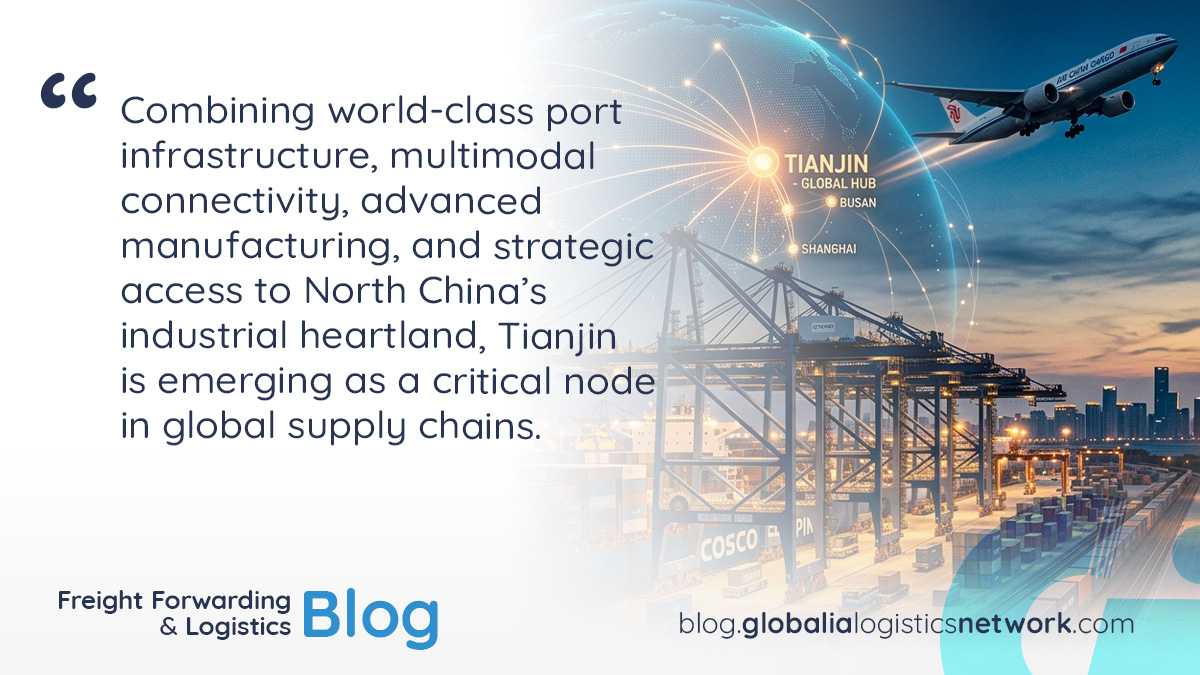
Shanghai will undoubtedly remain one of the world’s leading logistics gateways, but the future of Chinese exports is becoming increasingly distributed across multiple regional centers. The Tianjin logistics hub exemplifies this transformation. Combining world-class port infrastructure, multimodal connectivity, advanced manufacturing, and strategic access to North China’s industrial heartland, the city is emerging as a critical node in global supply chains.
For freight forwarders, understanding these evolving logistics ecosystems is no longer just about expanding geographic coverage. It is about identifying new opportunities, building resilient international partnerships, and offering customers smarter routing strategies in an increasingly dynamic trading environment. As supply chains continue to evolve, more logistics professionals are discovering that some of the most promising opportunities lie not in China’s traditional gateways, but in the rapidly growing logistics hubs that are quietly reshaping global commerce from the north.