

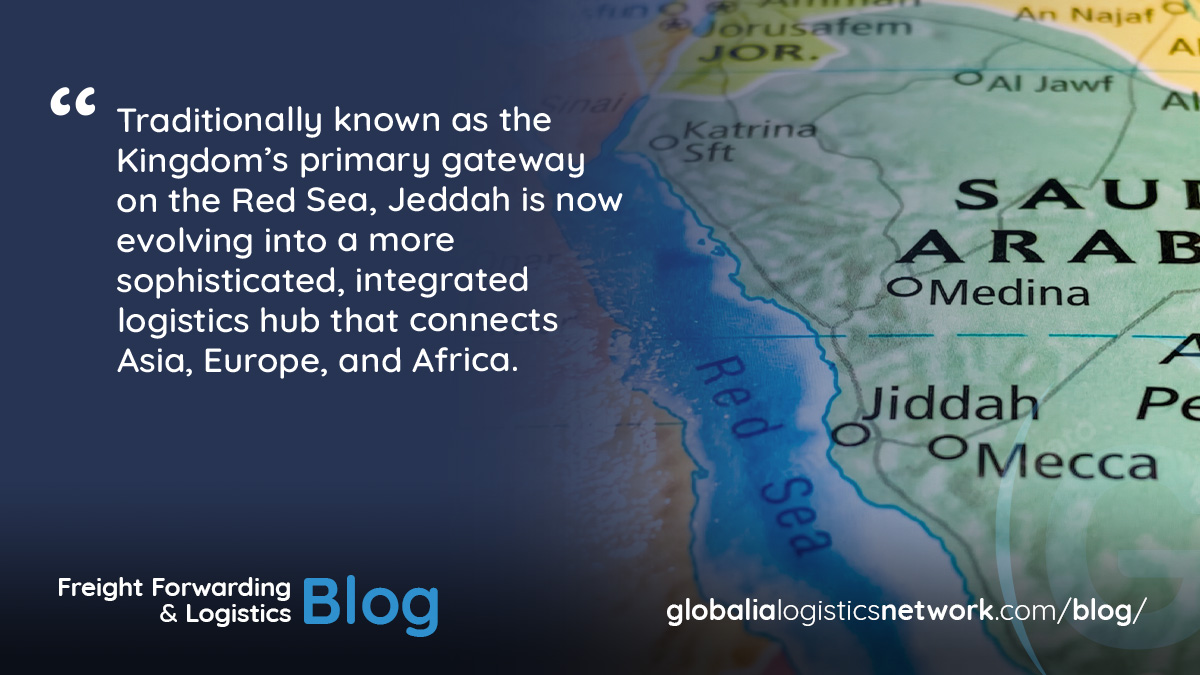
Saudi Arabia is in the middle of a structural shift. This isn’t incremental change or policy fine-tuning. Under Saudi Vision 2030, the country is actively reshaping its economy, with logistics sitting right at the center of that transformation. If you zoom in on Jeddah, the impact becomes even clearer. Traditionally known as the Kingdom’s primary gateway on the Red Sea, Jeddah is now evolving into a more sophisticated, integrated logistics hub that connects Asia, Europe, and Africa. For freight forwarders, this shift is opening up new opportunities while also raising expectations.
Why Jeddah Is Central to Saudi Arabia’s Logistics Strategy
Jeddah’s importance starts with geography. Positioned along one of the busiest maritime corridors in the world, the city provides direct access to Red Sea routes that link major global markets. The Jeddah Islamic Port handles a significant share of the country’s sea freight, making it a natural focal point for logistics development.
But Vision 2030 is pushing things further. The goal is to turn Saudi Arabia into a global logistics hub. That means investing in infrastructure, improving efficiency, and creating an environment where international trade flows more smoothly. Air cargo is also part of this equation. King Abdulaziz International Airport has been undergoing expansion and modernization, increasing its capacity to handle time-sensitive and high-value shipments. Together, the port and airport form a dual gateway that supports both volume and speed.
Trade Routes and Strategic Positioning
Jeddah’s location gives it a clear advantage when it comes to global trade routes. On the maritime side, it sits close to the Suez Canal, one of the most critical chokepoints in international shipping. This proximity allows faster transit times between Asia and Europe compared to longer alternative routes. For freight forwarders, this creates flexibility. Shipments moving from Asia to Europe can be routed through Jeddah for consolidation, redistribution, or even value-added services before continuing their journey. At the same time, the city acts as a gateway for imports into Saudi Arabia and exports to neighboring regions.
Jeddah also plays a growing role in connecting the Middle East with Africa. As trade between these regions expands, the city’s position on the Red Sea becomes even more valuable. Forwarders who understand these evolving routes can offer smarter, more efficient solutions to their clients. On the air freight side, Jeddah is strengthening its connections to Europe, Asia, and other Middle Eastern hubs. This is particularly important for industries that rely on speed and reliability, including pharmaceuticals, electronics, and high-value consumer goods.
Vision 2030: From Infrastructure to Efficiency
Here’s where things get interesting. Vision 2030 isn’t just about building bigger ports or expanding airports. It’s about improving how the entire logistics ecosystem functions.
Problem 1: Historical Bottlenecks and Delays
In the past, challenges like customs delays, paperwork inefficiencies, and limited coordination between stakeholders could slow down cargo movement.
Solution:
Saudi Arabia has been investing heavily in digitalization and process optimization. Initiatives aimed at streamlining customs clearance and reducing bureaucracy are making it easier to move goods in and out of the country. For freight forwarders, this translates into more predictable transit times and fewer unexpected disruptions.
Problem 2: Limited Integration Across Modes
A fragmented logistics system can create inefficiencies, especially when cargo needs to move seamlessly between sea, air, and land transport.
Solution:
Vision 2030 emphasizes multimodal integration. By improving connectivity between ports, airports, and inland transport networks, the country is creating a more cohesive logistics environment. This allows forwarders to design end-to-end solutions that are both faster and more cost-effective.
Problem 3: Capacity Constraints
As trade volumes grow, infrastructure needs to keep pace. Without sufficient capacity, congestion becomes inevitable.
Solution:
Ongoing expansions at Jeddah Islamic Port and King Abdulaziz International Airport are addressing this issue. Increased capacity, combined with modern handling facilities, is enabling the city to manage higher volumes without compromising efficiency.
Problem 4: Evolving Customer Expectations
Businesses today expect more than just transportation. They want visibility, reliability, and value-added services.
Solution:
The logistics sector in Saudi Arabia is adapting by adopting new technologies and service models. Real-time tracking, improved warehousing solutions, and integrated supply chain services are becoming standard offerings rather than optional extras.
What This Means for Freight Forwarders
For freight forwarders, the transformation of Jeddah is not just a background development. It directly affects how they operate and compete. On one hand, improved infrastructure and processes make it easier to deliver reliable services. On the other hand, the bar is higher. Clients expect forwarders to understand the new landscape, leverage available infrastructure, and provide solutions that go beyond basic transportation.
There’s also a clear opportunity to specialize. Whether it’s handling project cargo for large-scale developments, managing temperature-sensitive shipments, or supporting e-commerce growth, forwarders who align their services with Saudi Arabia’s evolving economy will be better positioned to grow.
Why Networking Matters More Than Ever in Jeddah’s Logistics Landscape
Expansion projects, rising trade volumes, and increasing regulatory complexity are reshaping how freight forwarders in Jeddah operate. In this kind of environment, having the right connections is what keeps operations running smoothly. In a market where coordination, timing, and trust are critical, your network can be the difference between delays and efficiency. This is where being part of a global freight network like Globalia Logistics Network becomes a practical advantage. It goes beyond visibility and directly strengthens your ability to operate in a rapidly changing logistics ecosystem.
Here’s how that translates for forwarders in Jeddah:
Territorial exclusivity
Globalia limits membership to one agent per city or port. That means you would be the sole representative from Jeddah within the network. In a key gateway city that connects Asia, Europe, and Africa, this exclusivity gives you a strong competitive edge. Partners looking for a trusted contact in Jeddah have a single, clear choice, increasing your chances of securing inbound business.
A stronger global reach
Globalia connects you with vetted partners in 175 plus territories worldwide, allowing you to extend your reach far beyond Saudi Arabia. You’re not just handling shipments locally, you’re part of a global network built on reliability and cooperation.
Consistent flow of project opportunities
As infrastructure expands and trade volumes increase, the need for steady business flow becomes even more important. Globalia encourages collaboration among members, creating a continuous exchange of shipments, leads, and project opportunities. For forwarders in Jeddah, this means access to international business that aligns with the city’s growing role as a logistics hub.
Tools, visibility, and operational support
Globalia supports its members with practical resources that go beyond day-to-day operations. From online tools that simplify processes like quotation generation to PR services that promote your company globally, the network helps you stay competitive. At the same time, the head office remains actively involved and accessible, offering guidance when needed.
Face-to-face connections that build long-term partnerships
Even in a digital-first industry, relationships still drive business. Globalia’s Annual Meetings bring members together for structured one-to-one meetings, allowing you to connect directly with partners and explore real opportunities. These interactions are especially valuable in a market like Jeddah, where trust and reliability play a key role in long-term success.
Final Thoughts
Vision 2030 is changing the rules of the game in Saudi Arabia’s logistics sector. Jeddah, with its strategic location and expanding infrastructure, is at the heart of this transformation. For freight forwarders, the message is clear. This is not a market to approach passively. It requires understanding, adaptation, and the ability to operate within a more advanced and competitive logistics environment.Those who embrace the change, invest in capabilities, and build strong global partnerships will be the ones who benefit the most. Because what’s happening in Jeddah isn’t just local progress. It’s a shift that’s reshaping regional and global trade flows.